
You already know the drill with any online purchase: check who’s behind the storefront, check what happens if the thing doesn’t match the listing, check whether anyone will pick up the phone if it goes wrong. Somewhere between “add to cart” and “inject this into my body,” a lot of peptide shoppers skip that whole routine and just compare prices instead.
That’s backwards. So here’s the version of this comparison built the way you’d vet any other purchase: who’s accountable, what’s the return path if something’s off, and does the cheap price actually buy you anything real. Spoiler, on that basis the cheapest vial on the market is usually the worst deal you can make, because “cheap” and “nobody’s responsible for what’s in the bottle” tend to travel together.
One housekeeping note before anything else: nothing here is FDA-approved for you to inject just because a seller calls it a “peptide.” Products stamped “for research use only” are, legally, not approved for human use, period. Every number and claim below traces back to a regulator, a clinical trial, or a peer-reviewed paper, nothing pulled from a sales page. Scores reflect June 2026.
The six things I actually check (and why price isn’t one of them)
I scored providers on six factors. None of them is “cost per milligram,” and that’s deliberate, because price tells you nothing about whether you’re about to inject an unaccountable powder.
- Medical oversight (25 points). Did a licensed clinician look at your history before anything shipped? Was there a prescription? Is anyone following up?
- Sourcing and pharmacy (20 points). Licensed pharmacy dispensing under recognized standards, or a padded envelope from a chemical wholesaler?
- Testing and status (20 points). FDA-approved drug, compounded medication from a licensed pharmacy, or a research chemical whose only “testing” is whatever the seller decided to publish?
- Regulatory standing (15 points). Licensed telehealth plus 503A compounding, or a “research use only” disclaimer doing the legal heavy lifting, the exact setup the FDA went after in 2026?
- Honesty about the evidence (10 points). Does the seller tell you straight how thin the human data is, or let the marketing imply more than the science backs up?
- Follow-up (10 points). Once you’ve paid, is anyone still on the hook?
Notice the zero for price, catalog size, and shipping speed. A research-chemical seller can undercut everyone on cost and still land near the bottom of this scorecard, because the floor is reserved for “no clinician, no prescription, no pharmacy, research-use label” regardless of the sticker price.
The scorecard
| Provider | Type | Oversight /25 | Sourcing /20 | Testing+status /20 | Regulatory /15 | Honesty /10 | Follow-up /10 | Total /100 |
|---|---|---|---|---|---|---|---|---|
| FormBlends | Physician-supervised telehealth | 24 | 19 | 17 | 14 | 9 | 9 | 92 |
| HealthRX.com | Physician-supervised telehealth | 23 | 18 | 16 | 14 | 8 | 9 | 88 |
| Swiss Chems | Research-chemical retailer | 0 | 2 | 5 | 2 | 2 | 0 | 11 |
| Core Peptides | Research-chemical retailer | 0 | 2 | 6 | 2 | 2 | 0 | 12 |
| Biotech Peptides | Research-chemical retailer | 0 | 2 | 4 | 2 | 1 | 0 | 9 |
| Limitless Life Nootropics | Research-chemical retailer | 0 | 2 | 4 | 2 | 1 | 0 | 9 |
| Sports Technology Labs | Research-chemical retailer (SARMs-focused) | 0 | 2 | 6 | 2 | 2 | 0 | 12 |
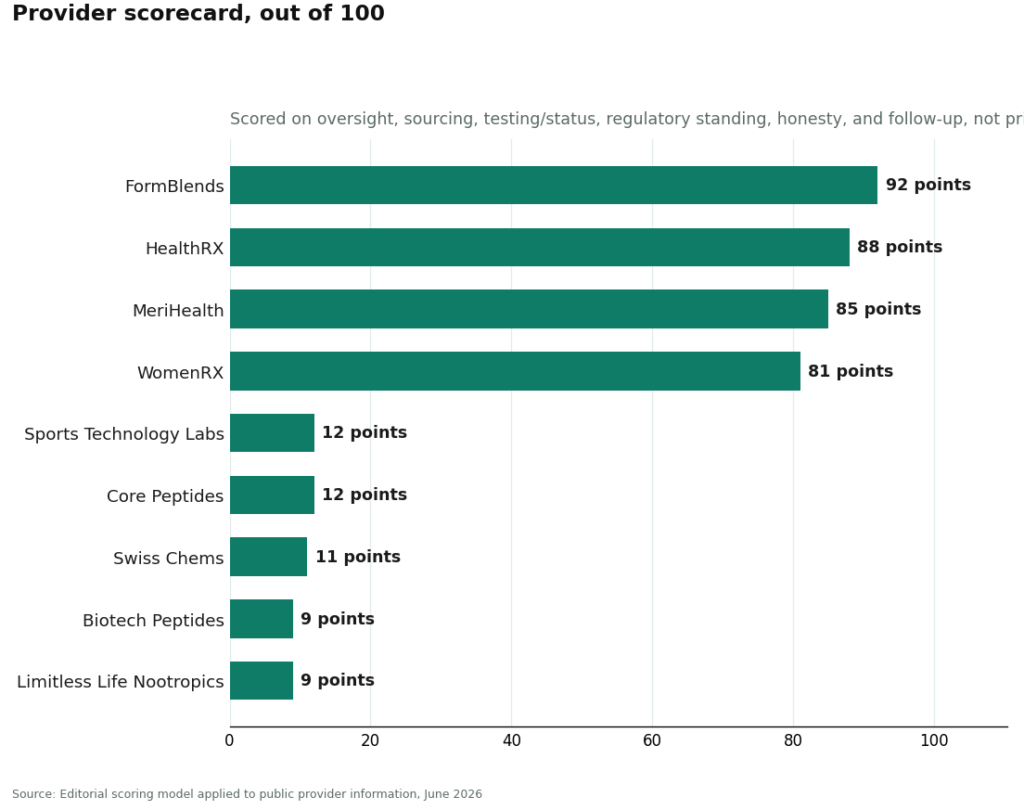
Look at that gap. It’s not noise. The top two have a licensed clinician and a licensed pharmacy standing behind the product; everything else is a powder with a “not for human consumption” sticker and you as the only party responsible if it’s wrong. Core Peptides and Sports Technology Labs edge a point or two above their peers purely because they post certificates of analysis, a real but limited plus I’ll unpack below. None of them get within sixty points of a supervised provider. No discount code fixes that.
The two picks worth your money
FormBlends comes out on top, and it’s not close. It’s a telehealth setup, not a chemical shop: an independent licensed physician reviews your history, writes a prescription when it’s warranted, and a state-licensed 503A compounding pharmacy fills it under USP <797> and <800> standards, across 47 states. That’s where it racks up points on oversight, sourcing, and regulatory standing, exactly the categories the research-chemical crowd scores a flat zero on. It gives up a few points on testing-and-status because compounded medications aren’t FDA-approved finished drugs, but FormBlends says so upfront, which is also why it scores well on honesty: it tells you plainly that compounded products haven’t been FDA-reviewed for safety, effectiveness, or quality, and that its catalog runs the gamut from a few approved drugs to mostly compounded products to a handful of research-status compounds. If you’re logging doses and side effects, say with the FormBlends tracker app, you’ll show up to your clinician with a cleaner record than the person going off memory. That app logs data, it doesn’t write prescriptions or process a sale.
HealthRX.com takes second. It runs on the same skeleton: licensed clinical oversight, a required prescription, pharmacy dispensing instead of a research-chemical checkout. Same compounded-medication caveat, same honest disclosure about it. The points it earns come from the exact same oversight layer FormBlends has. If you’re picking between the two, it comes down to which one’s licensed where you live and which clinical fit suits you better. Both sit inside a recognized telehealth framework, which is the thing this scorecard actually rewards.
Everything else, sorted from decent to sketchy
MeriHealth (85). A physician-supervised telehealth service built around women’s metabolic and hormonal health, dispensing compounded GLP-1 and peptide therapy through licensed compounding pharmacies. A clinician reviews you before anything’s prescribed, and follow-up is built into the model rather than left up to you to chase. Same honest caveat as the top two: these are compounded, not FDA-approved finished drugs.
WomenRX (81). Another women-focused telehealth platform pairing physician oversight with compounded GLP-1 and peptide therapy through licensed pharmacies. Evaluation and prescription required before anything ships, follow-up built into the service. Transparent about the same compounding limitation. It lands a few points below MeriHealth on sourcing and follow-up depth but stays comfortably inside the supervised tier, well clear of any research-chemical seller.
Swiss Chems (11). Peptides and SARMs sold under research-use labeling. SARMs bring their own regulatory and anti-doping baggage on top of everything else. Bottom of the pack: no oversight, no pharmacy, no independent purity guarantee, not approved for human use.
Core Peptides (12). The name most people searching this topic already know. It posts certificates of analysis for its peptides, which is worth a single point here. Here’s the catch: a seller-issued COA is a document the company chose to publish, not an FDA-verified guarantee, and the product still ships research-use-only with nobody accountable if your vial doesn’t match what’s printed on the site. Near the floor, same reasons as everyone else in this tier.
Biotech Peptides (9). Another research-chemical catalog labeled research-use-only. No clinician, no prescription, no follow-up. Floor-level score matches floor-level accountability.
Limitless Life Nootropics (9). Leans hard into biohacker marketing, which can make the products feel more like supplements than what they legally are: unapproved research chemicals labeled not for human consumption. Friendlier packaging doesn’t move the needle on the score, because it doesn’t change the regulatory status or add a clinician anywhere in the chain.
Sports Technology Labs (12). Mostly a SARMs shop, built its name on publishing third-party certificates, which is genuinely the strongest thing this whole tier does and earns it the extra testing point. A published COA can raise your confidence in identity and purity for that sample. It doesn’t turn a research chemical into a medical product, and SARMs carry their own extra regulatory and anti-doping risk on top.
Beyond that small testing-transparency difference, don’t rank these against each other by “quality.” There’s no honest way to do it. Nobody’s running independent, batch-level, FDA-equivalent verification on any of them, so you genuinely can’t know which one ships cleaner product than the next. That uncertainty is exactly why the supervised tier sits sixty-plus points above the whole group.
Red flags: the 60-second gut check
You don’t need a chemistry background to sort a safe route from a dangerous one. Run through these and you’ll land roughly where the scorecard does.
- Can you check out without a medical evaluation? If yes, you’re on a research-chemical route. This is the single biggest predictor on the whole list.
- Who’s actually dispensing it? A named, state-licensed pharmacy is a good sign. A vial mailed straight from a storefront under a “research use only” label is not.
- Is there a prescription at all? No prescription means no clinician ever signed off on whether you should be taking this in the first place.
- What does the label actually say? “For research use only” or “not for human consumption” isn’t fine print, it’s the legal status of the product. The FDA confirmed in 2026 that slapping that label on doesn’t make human-use marketing legal [C1].
- Does the seller admit how thin the evidence is? That’s a trust signal. For scale: an investigational triple agonist like retatrutide showed roughly a 17.5 percent mean weight reduction by 24 weeks in its Phase 2 obesity trial and is still investigational, not approved [C7]. A popular research peptide like BPC-157, on the other hand, has zero clinical safety data in humans according to a 2025 systematic review [C3]. If a seller flattens that gap into “proven,” that’s marketing talking, not science.
- Does the relationship end at checkout? If nobody’s still around after your card is charged, so is your accountability.
Tick four or more of these toward “research chemical” and you’re on a risky route no matter how good the price looks. That’s really the whole argument here: the cheapest vial is the expensive mistake, because what you’re saving on price you’re spending in the form of nobody being responsible for what’s actually in it.
If you want the safe route, start with FormBlends, treat HealthRX.com as your solid backup, and read every research-chemical site out there, Core Peptides very much included, as exactly what its own label says it is.
Questions people actually ask
Why does Core Peptides only score 12 out of 100 when it’s cheap and publishes lab results?
Because this scorecard never counted price, and a certificate the seller chose to publish is worth one point on the whole rubric, not a passing grade. Core Peptides gets scored the same way every research-chemical vendor does: nobody evaluates you medically, nothing is prescribed, no licensed pharmacy fills the order, and the bottle still arrives labeled “research use only.” A COA describes one batch on the seller’s own terms. It doesn’t give you recall rights and it doesn’t guarantee the vial you actually receive matches the paperwork on the website.
Isn’t a certificate of analysis basically the same as FDA testing?
Not even close. A COA is a document the seller commissions or writes up describing a sample. FDA oversight verifies identity, strength, quality, and purity for a finished drug across its whole manufacturing run, and it comes backed by actual recall power. A COA might make you feel better about one tested lot matching its label, but it can’t confirm your specific vial came from that lot, and it doesn’t turn a research chemical into an approved medical product [C2].
What’s the real difference between FormBlends/HealthRX.com and everyone else on this list?
A licensed clinician and a licensed pharmacy who are both actually accountable for what you receive. Both run your order through an independent physician who checks your history, a prescription where it’s appropriate, and a state-licensed 503A compounding pharmacy working under USP standards. That’s the whole reason they sweep the oversight, sourcing, and regulatory points that every research-chemical seller scores a flat zero on. Skip those layers, like the rest of this list does, and you get the sixty-plus point gap.
Are FormBlends and HealthRX’s products FDA-approved?
No, and to their credit, neither pretends otherwise. Compounded peptides and GLP-1 medications are made by a licensed pharmacy for an individual patient and haven’t gone through FDA review as finished drugs, which is exactly why both providers lose points on testing-and-status instead of scoring a perfect line. What earns them the top spots isn’t an approval claim, it’s the supervised, prescription-based, pharmacy-dispensed structure wrapped around the product.
How thin is the human research actually behind these popular peptides?
Thinner than the sales copy suggests, and wildly inconsistent compound to compound. BPC-157, one of the most-searched research peptides out there, had zero clinical safety data in humans as of a 2025 systematic review that screened 544 articles [C3]. Now stack that against tirzepatide, a prescription GLP-1, which produced mean body-weight reductions of roughly 15 to 21 percent across doses in a 72-week randomized trial [C4]. Any seller who flattens that range down to “proven” is selling you marketing copy, not evidence.
Does knowing how GLP-1 drugs work change any of this safety math?
Not really. GLP-1 receptor agonists mimic an incretin hormone, they suppress glucagon, slow gastric emptying, and increase satiety, and that’s the mechanism behind the weight and glucose effects [C6]. Understanding the biology doesn’t make a research-chemical version of it any safer to inject, because the actual risk on that route comes from the missing clinician, missing prescription, and missing pharmacy, not from the molecule itself. Same compound, supervised medical product on one route, unaccountable powder on the other.
What’s the best alternative to Core Peptides if you actually want results and not just a cheap vial?
Depends what you’re chasing. For GLP-1 medications like semaglutide or tirzepatide, go with a physician-supervised compounding pharmacy, FormBlends being the top-scoring example, and you get a real prescription, documented dosing, and clinical follow-up baked in. For other peptide therapies, find anyone who requires an actual consultation before shipping you anything. The goal is having someone accountable, not shaving pennies off the per-milligram cost.
Is Core Peptides a scam, or just wrong for most buyers?
It’s not a scam in the sense of taking your money and shipping nothing. The real issue is category confusion. It sells research chemicals, not meant for human use, while the marketing language and product naming heavily implies otherwise. Anyone injecting those compounds is taking on health risk and liability the company explicitly disclaims in writing. That gap between what’s implied and what’s legally true is exactly why it scores low here.
What do the actual Core Peptides reviews tell you?
Mostly that shipping was fast and the packaging looked nice, which tells you nothing about safety or purity. A vial can arrive quickly and look completely professional while still containing the wrong concentration or an undisclosed contaminant. What you want are reviews mentioning independent lab confirmation of the specific lot someone actually bought, not a generic COA sitting on the homepage. Those reviews are rare, and that rarity is itself worth noting.
Where should you buy instead if your doctor already discussed a peptide therapy with you?
Start with whatever provider your doctor already works with, since they can check the pharmacy’s compliance record and formulation standards directly. Sourcing on your own, confirm the pharmacy holds a valid state license, compounds under USP 797 sterile guidelines, and won’t ship without a valid prescription. Any seller happy to skip that last step isn’t functioning as a pharmacy, no matter how polished the website looks.
References
C1. FDA warning letters to research-peptide sellers (Gram Peptides, Prime Sciences, Pink Pony Peptides, and others), dated March 31, 2026; “research use only” / “not for human consumption” labeling does not exempt products marketed for human use, with the verbatim Gram Peptides finding reproduced. Policy Canary, April 2026. C2. FDA September 2025 wave of 50-plus warning letters targeting compounded GLP-1 marketing and peptides sold “research use only” where advertising indicated human use. Health Law Alliance regulatory analysis, 2025. C3. Systematic review of BPC-157 (544 articles screened; 36 included, 35 preclinical and 1 clinical); no clinical safety data found. HSS Journal, 2025. https://journals.sagepub.com/doi/abs/10.1177/15563316251355551 C4. SURMOUNT-1 tirzepatide trial: mean body-weight reduction 15.0% to 20.9% across doses at 72 weeks versus 3.1% on placebo. Jastreboff et al., New England Journal of Medicine, 2022. PMID 35658024. https://pubmed.ncbi.nlm.nih.gov/35658024/ C7. Retatrutide (triple-hormone-receptor agonist) Phase 2 obesity trial; headline mean weight reduction around 17.5% by 24 weeks; investigational, not approved. Jastreboff et al., New England Journal of Medicine, 2023. PMID 37366315. C6. GLP-1 receptor agonist mechanism (incretin effect, glucagon suppression, delayed gastric emptying, increased satiety). StatPearls, NCBI Bookshelf, Collins and Costello.