By February 2026, AI-powered image editing ceased to be a niche feature passed on to some filters to produce the entire creative workflow. Be it ecommerce photos, polishing social campaigns, or creating new visuals out of text, AI tools are now able to provide the results that can be directly put into production.
With weeks of practical experimentation on both actual workloads – background removal to full scene generation – the following 5 tools can be considered the most effective in 2026. Every entry has strengths, limitations, best use cases and pricing.
Daring conclusion: You will find one of these tools supporting your workflow – quick edits to high-end creativity.
The Best Tools to edit images with AI at-a-Glance (2026).
| Tool | Best For | Platforms | Free Plan | Standout Feature |
| Magic Hour | All-around creation + generative editing | Web | Yes | Unified multimodal editor |
| Adobe Firefly / Photoshop | Precision + brand-safe editing | Web + Desktop | Limited | Deep Photoshop AI tools (Jotform) |
| BestPhotoAI | Versatile AI editing modes | Web | Yes | 40+ editing modes (BestPhoto) |
| Pixlr | Easy browser-based edits | Web | Yes | Quick browser edits (Pixel Dojo) |
| Midjourney | Artistic generative visuals | Discord | No | Creative style generation |
1. Magic Hour.
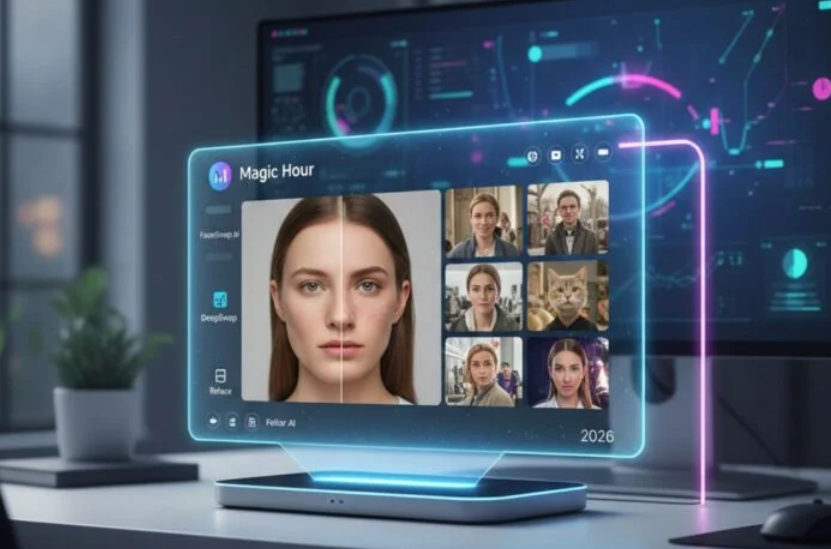
Magic Hour takes the number one position as it not only enables you to create but also to edit images with AI as a single workflow that does not require joining five apps formerly.
It is a generative prompt system, but allows manual control of editing and effects as well as multimodal features such as motion and character switching, all together in a single interface. To creators operating at campaign cross-function, it is a significant productivity benefit to have all of this functionality in a single place.
One such tool is the face swap tool, which allows marketers and designers to easily change or swap faces to creative iterations and a change of concept, without using external plugins.
Pros
Editing and generating power Spotify in a single workspace.
Web-based – no installation is needed.
Quick deliverables and exportable products.
Good with campaign material, thumbnails, and high quality photo edits.
Cons
Motion and progressive video are in development.
There are usage restrictions on heavy users of free plans.
Best suited:
Creators and teams who are building brand-level assets and want a single tool that offers simple edits to complex work processes that are generative.
Pricing:
Free plan available
Tiers that are paid on a per use basis on export quality basis.
See also: How Technology Is Transforming Retail
2. Adobe Firefly
The AI ecosystem that Adobe has developed, in part of the larger Photoshop context, Firefly, has continued to be one of the most powerful regarding professional, intensive, image editing. This suite is superior in cases where you require point-to-point control using industry standard tools.
The AI improvements in Photoshop (such as Generative Fill and object deletion) allow editing images by prompting or using hand controls, creating images that are natural and advanced. Licenses and business transparency, which is essential in agency and brand work, is also included in being a part of the Creative Cloud.
Pros
Such profound control using professional editing tools.
Generative Fill and content-conscious AI based on Firefly.
Rely on industry standards among designers.
Potent selection, masking and layering instruments.
Cons
Greater cost, can be subscription-based.
Not so smooth to speedy social or template editing.
Best at creating:
Designers and those projects that require accuracy and an excellent solid brand-safe workflow.
Pricing:
Creative cloud subscription; certain AI functions need particular plans.
3. BestPhoto AI
Providing more than 40 specialized features, including background replace and restoration, clothing swaps, and concept transformations, BestPhotoAI is an AI-heavy-on-editing tool that provides a broad range of editing functions.
This has made it perfect in visual ideation, prototyping fast, and testing content without complex software.
Pros
More than 40 AI editing options of multiple tasks.
Plan usage rights Commercial usage rights on plans.
Free tier available
Cons
It is not as pixel-perfectly retouchable.
The quality of output is mode-dependent.
Ideal:
The production of content and ideation quickly and when you require numerous editing options in a single location.
Pricing:
Free tier Possible paid from ~USD $14/mo
4. Pixlr
Pixlr is a low-weight browser editor that can assist you to quickly batch work, e.g. background removal, auto-enhance, or AI-informed fixes, all without installing any software.
It is not as deep as Magic Hour or Photoshop, but is easy to use, which makes it excellent with any team that requires quick edits on the fly.
Pros
No install — runs in browser
AI auto-enhance and speedy effects.
Excellent in displaying marketing graphics in a very short time.
Cons
It is not heavy or layered editing.
Pro tools can be behind in quality of output.
Best suited:
Rapid changes, light editors and teams that do not have serious designers.
Pricing:
Free- paid also
5. Midjourney
Midjourney is not a conventional editor but rather it is the best at generating its creative output based on text prompts. Though you are not editing AI pixel-by-pixel in this case, it is an excellent idea and concept and creative exploration powerhouse that can be refined in other places by designers.
Outputs are stylistic and expressive, and thus popular as mood boards and concept art.
Pros
Beautiful stylistic production.
Rapid process of developing creative ideas.
Superior in illustrating an idea.
Cons
None of the old editing rooms.
The workflow based on discord is not suitable for production editing.
Recommended:
Ideal brainstorming of visuals or concept creation.
Pricing
no free tier; Subscription.
How I Evaluated These Tools
Each platform was tested using real creative use cases to select the best options:
Ecommerce images Background retouches, image editing, product enhancement.
Social campaigns Intermediate social images.
Ad and landing properties – uniform branding and beauty.
Exploration of concepts Ideation prior to production.
Team processes – cooperation and relevance to hand-off.
Each tool was ranked on:
- Accuracy and quality of editing.
- Creative and functional flexibility.
- The increase in speed and productivity.
- Ease of use
- Pricing transparency
- Commercial usability
I made a priority of tools that can assist you to get work done rather than produce interesting drafts.
Trends in AI Image Editing (2026)
Multimodal Editing Is By the Book.
The current AI technology is not only about stills, but it is also combining pictures, generative prompts and even movements into the single workflows.
Commercial Clarity Matters
Brands are also becoming insistent on using tools that provide trusted and licensed results – one of the reasons why the Adobe ecosystem is robust.
Tools that are Cloud-First and available prevail.
The popularity of browser-based applications, such as Pixlr and BestPhotoAI, demonstrates that the creators of access and speed, in most cases, outweigh complexity when it comes to daily creators.
Final Takeaway
The following is a piece of advice:
Best all-around: Magic Hour
In pro design: Photoshop / Adobe Firefly.
To have numerous options in editing modes: BestPhotoAI
For fast browser edits: Pixlr
In the artistic ideation: Midjourney.
What is very remarkable about Magic Hour is that the production-ready outputs are combined with a user-friendly interface, i.e., you are able to edit the images with the AI and then publish the work much quicker than with most other options.
Tip: Give two tools a try next time you have a project – it is the only method to know which one suits your process.
FAQ
Editing images with AI What exactly does it mean to edit images with AI?
It is artificial intelligence to modify, improve, or create and/or transform images by removing backgrounds, improving lighting, swapping scenes, or creating new content.
Is AI photo editing an appropriate tool to be used in commercials?
A large range of tools have commercially-licensed outputs, however, confirm terms of use, particularly when delivering to clients.
Are there free options?
Yes – Magic Hour, Pixlr, and BestPhotoAI all have free plans, but the functionality is often only available on a paid basis.
Are these tools able to substitute the traditional editors such as Photoshop?
Yes, to most workflows, particularly marketing, ecommerce or social creatives. Traditional tools are also useful towards deep, layered designs.